A flange plunger may help with a simple toilet blockage when the bowl has room and there are no signs of a wider problem. If other drains are slow too, or the overflow relief gully outside is spilling, there may be a wider drainage problem requiring your water company or a licensed plumber.
Try this first
- Stop flushing. Another flush can overflow the bowl. If you know the toilet's accessible isolation tap and can reach it safely, turn the supply off. Do not dismantle a concealed cistern.
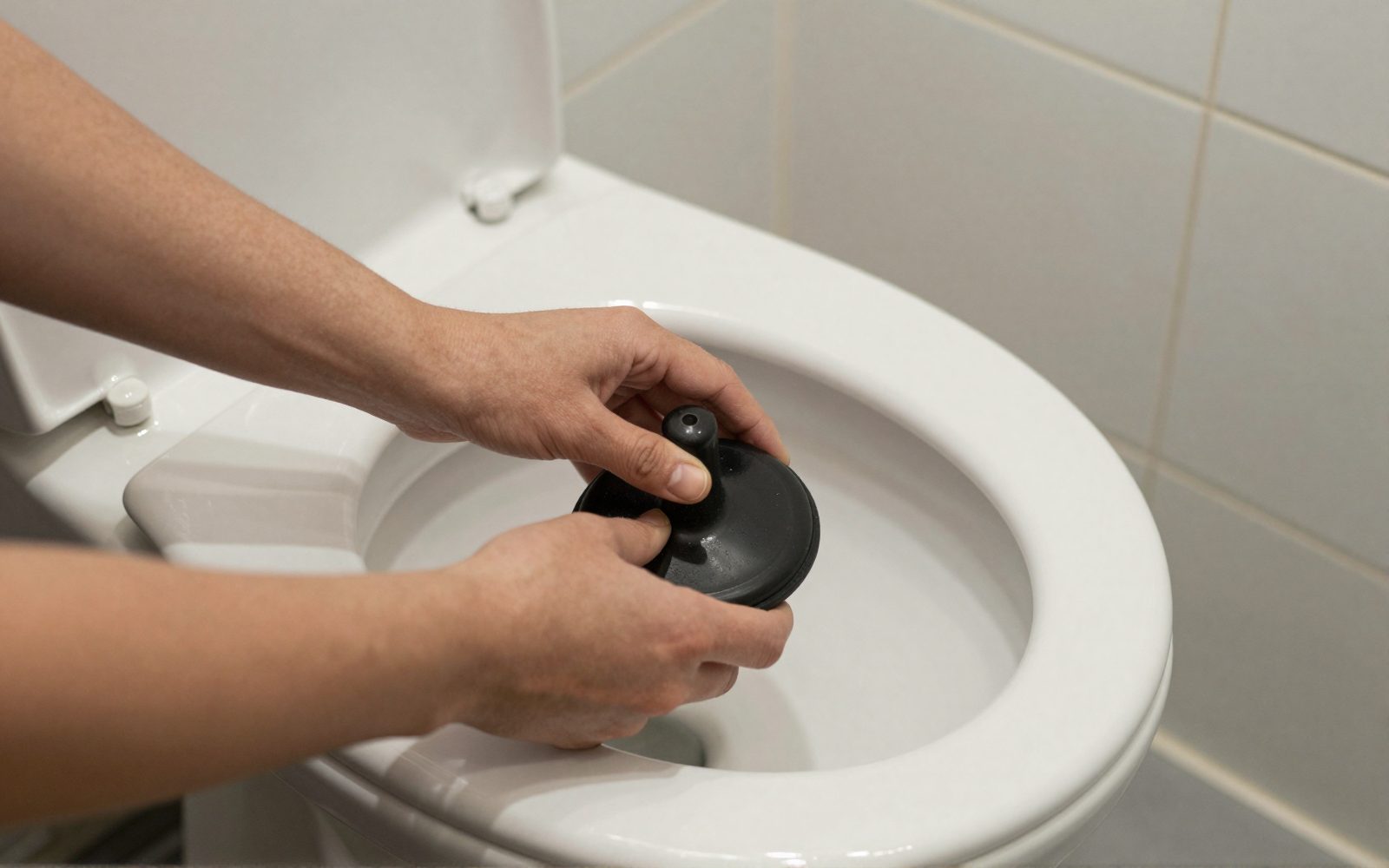
- Use a flange plunger. The kind with a soft sleeve that fits into the toilet outlet. Seat it so it seals, then push gently and pull back hard, 10 to 15 times.
- Do not add water to a full bowl. If the water level remains high or rises again, stop and arrange help.
- Check the result cautiously. If the level has not returned to normal, do not flush again. Repeated blockages need investigation.
What not to pour
Boiling water can crack a porcelain bowl. Caustic drain cleaners can splash back and harm older pipes; if you do use one, follow the label exactly and never mix products. Never pour anything down a toilet that is already full.
When it is the sewer, not the toilet
- Water rises in the shower or floor waste when you flush.
- Several fixtures are slow or gurgling at once.
- The overflow relief gully outside is wet, smelly or spilling.
Those signs can indicate a wider drainage problem; they do not locate the blockage on their own. Pipes on your property are yours to fix with a licensed plumber; call your water company first if sewage is overflowing (Yarra Valley Water: 13 27 62). See whose pipe it is.
Who fixes it: You, the owner, with a licensed plumber.
Who to call: A licensed plumber.
Who fixes it: You: the owner must keep it working. It lets sewage spill outside instead of inside.
Who to call: A licensed plumber, or the water company first if sewage is overflowing.
Who fixes it: You: everything from the connection point to the house is your private pipe.
Who to call: A licensed plumber. Ask the water company first if several houses are affected.
Who fixes it: For Yarra Valley Water, responsibility ends at the inspection opening or up to 1 metre inside the boundary, whichever is less. Ask the utility to confirm your connection.
Who to call: Yarra Valley Water faults, 13 27 62, for most of the north and east.
Who fixes it: The water company.
Who to call: Your water company's faults line (13 27 62 for Yarra Valley Water).
Who fixes it: Yarra Valley Water maintains the main-to-meter pipe, stop tap and meter in the usual setup. Internal pipes, private extensions and private mains can be the owner's responsibility.
Who to call: Water company for a meter or street leak; a licensed plumber for your side.
Who fixes it: You, with a licensed plumber; gas units need a licensed gasfitter.
Who to call: A licensed plumber or gasfitter.
From Yarra Valley Water's repair responsibilities, checked 16 October 2026. This drawing is schematic; connection and meter arrangements vary. Check your bill for your utility and confirm the actual repair boundary.
What you may do yourself in Victoria
The state's plumbing regulator says the plumbing everyday Victorians may do is limited to small jobs, such as fixing a leaking tap. Clearing a toilet with a plunger is maintenance; anything that means opening up pipes or drains is a job for a licensed plumber.
Common questions
Will a blocked toilet unclog itself?
Sometimes, if the blockage is paper and you wait an hour or two. If it is a solid object, wipes or roots, it will not.
Why won't my toilet unclog with a plunger?
The plunger may not be sealing (use a flange plunger), the object may be solid, or the blockage may be in the sewer beyond the toilet. If other drains are slow too, call a plumber.
Check whether the problem is confined to this toilet
Before using a plunger, look at what has already happened elsewhere. Have other fixtures drained normally, or has water appeared in a shower or floor waste? Observe existing symptoms without repeatedly flushing or running more water to create a test. Several affected fixtures are a reason to stop and arrange investigation.
An isolated toilet blockage and a wider drainage restriction can look similar at first. A plunger that moves the bowl water does not establish that the whole drain is clear. If the problem returns, record the sequence and tell the plumber rather than repeating the same intervention every day.
If an object may have been dropped in, say so when arranging help. A toy, sanitary item or cleaning attachment raises a different question from excess toilet paper. Do not push a rigid tool into the outlet or try to retrieve an object by dismantling the pan.
When plunging is the wrong next step
Stop if the bowl is close to overflowing, sewage is appearing elsewhere, the fixture is damaged or you cannot work without splashing contaminated water. Keep children and pets away from an affected area. If a chemical product has already been added, tell the plumber what it was and follow its safety instructions; do not add another product or plunge liquid that could splash chemicals.
A plunger needs a seal suited to the toilet outlet. An ordinary flat cup may work poorly on that shape. If it will not seal, forcing it harder is not a useful way to establish the cause. Use appropriate equipment within its instructions or arrange a professional assessment.
Avoid assuming that a blockage has cleared merely because the level falls slowly. Check for normal operation cautiously after the level returns to normal, and stop again if it rises. A repeated blockage needs its cause investigated, not a permanent routine of extra flushing.
What to tell the water company or plumber
Give the address, the affected fixtures, when the problem began and whether any outdoor sewer fitting is spilling. Say whether other properties appear affected if you already know; do not enter another property or open sewer access points to find out.
For an invented call description: “The toilet rose after one flush, the shower also has water standing in it, and we have stopped using both.” That is a useful symptom record without claiming to know where the blockage sits or who must pay.
Ask who will investigate, whether there is a call-out charge and what work is proposed before it starts. Keep the diagnosis and any recommended follow-up with the invoice. The plumber-cost guide explains quote questions, while tree roots in pipes covers recurring drain investigations.
Sources
- Plumbing Regulations 2018, version 010 in force from 1 May 2026, regulation 13 and minor-tap-repair definition, checked 16 October 2026
- Yarra Valley Water, Repair responsibilities
- Yarra Valley Water, Report a fault
Checked 16 October 2026. Rules and prices change; check with the regulator, your water company or a licensed plumber.